
Choosing the right sheet metal fabrication machines is one of the most important decisions for a metalworking factory. A complete workshop usually does not rely on only one machine. Instead, it needs a combination of cutting, shearing, punching, grooving, bending, rolling, pressing, welding, and inspection equipment.
For many factories, production problems do not come from one single machine. They often come from an unmatched equipment configuration. For example, a laser cutting machine may not have enough power to cut thick plates, or a press brake may not have enough tonnage to bend the required material. In real production, this can cause slow delivery, repeated testing, unstable quality, and higher labor cost.
This guide explains how metalworking factories can choose suitable sheet metal fabrication machines according to material type, material thickness, workpiece size, accuracy requirements, production capacity, budget, and workshop layout.
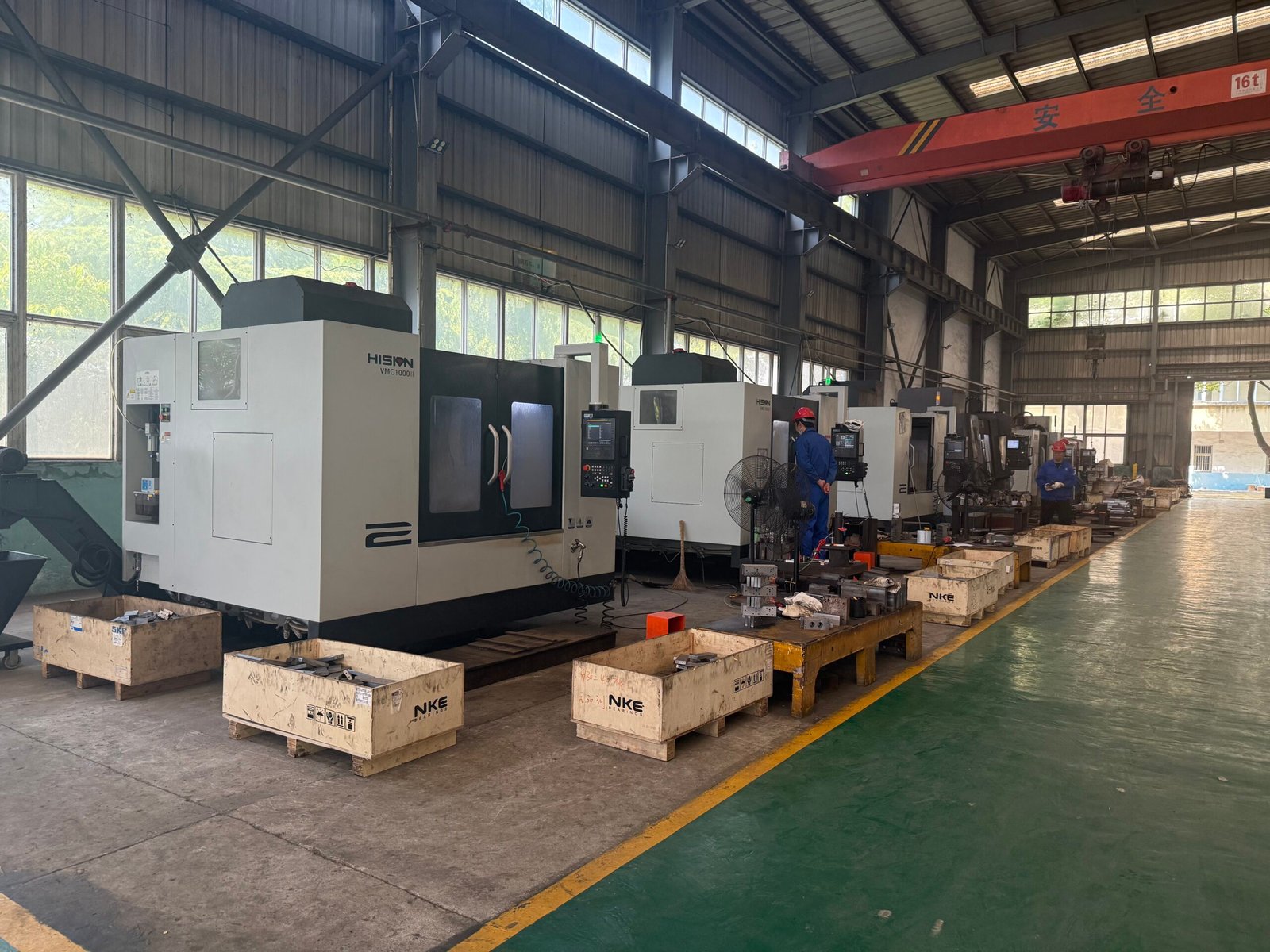
1. What Are Sheet Metal Fabrication Machines?
Sheet metal fabrication machines are used to process metal sheets into finished parts or semi-finished components. These machines are widely used in metal fabrication workshops, electrical cabinet production, automotive parts manufacturing, elevator manufacturing, aerospace components, shipbuilding, construction, machinery manufacturing, and general industrial production.
A complete sheet metal processing workflow may include:
- Material preparation
- Laser cutting
- Shearing
- Punching
- V grooving
- Bending
- Rolling
- Pressing
- Welding
- Surface treatment
- Assembly
- Final inspection
Different factories need different equipment combinations. A small workshop may only need a shearing machine and a press brake. A modern metal fabrication factory may need a fiber laser cutting machine, CNC press brake, panel bender, V grooving machine, punching machine, rolling machine, hydraulic press, and welding equipment.
The key is not to buy every machine at once. The key is to choose the right machines based on your real production requirements.
2. Common Machines Used in a Metal Fabrication Workshop
A metal fabrication workshop may use different machines depending on the product type, material thickness, order volume, and required accuracy.
| Machine Type | Main Function | Typical Application |
|---|---|---|
| Laser Cutting Machine | Cuts flat sheet metal or tubes with high precision | Complex shapes, stainless steel, carbon steel, aluminum parts |
| Shearing Machine | Cuts sheet metal in straight lines | Simple plate cutting, batch sheet preparation |
| Punching Machine | Creates holes, slots, and formed features | Electrical cabinets, panels, mounting plates |
| V Grooving Machine | Creates V grooves before bending | Stainless steel panels, sharp bending, decorative metal parts |
| Press Brake | Bends sheet metal into different angles | General sheet metal bending, cabinets, enclosures, structural parts |
| Panel Bender | Automatically bends panel-type workpieces | Electrical cabinets, elevator panels, metal doors |
| Rolling Machine | Rolls metal plates into curved or cylindrical shapes | Tanks, pipes, round parts, construction components |
| Hydraulic Press | Pressing, forming, straightening, and assembly | Metal forming, press fitting, correction, deep drawing |
| Welding Equipment | Joins metal parts together | Assembly, frames, enclosures, structural parts |
For factories planning a new workshop or equipment upgrade, it is better to think about the whole production process instead of only comparing single machine prices.
3. Standard Sheet Metal Fabrication Process
A typical sheet metal fabrication process can be understood as:
Cutting → Shearing → Punching → V Grooving → Bending → Rolling → Pressing → Welding → Inspection
Not every project needs every step. For example, simple sheet metal parts may only require cutting and bending. Complex industrial parts may need cutting, punching, V grooving, bending, welding, and surface finishing.
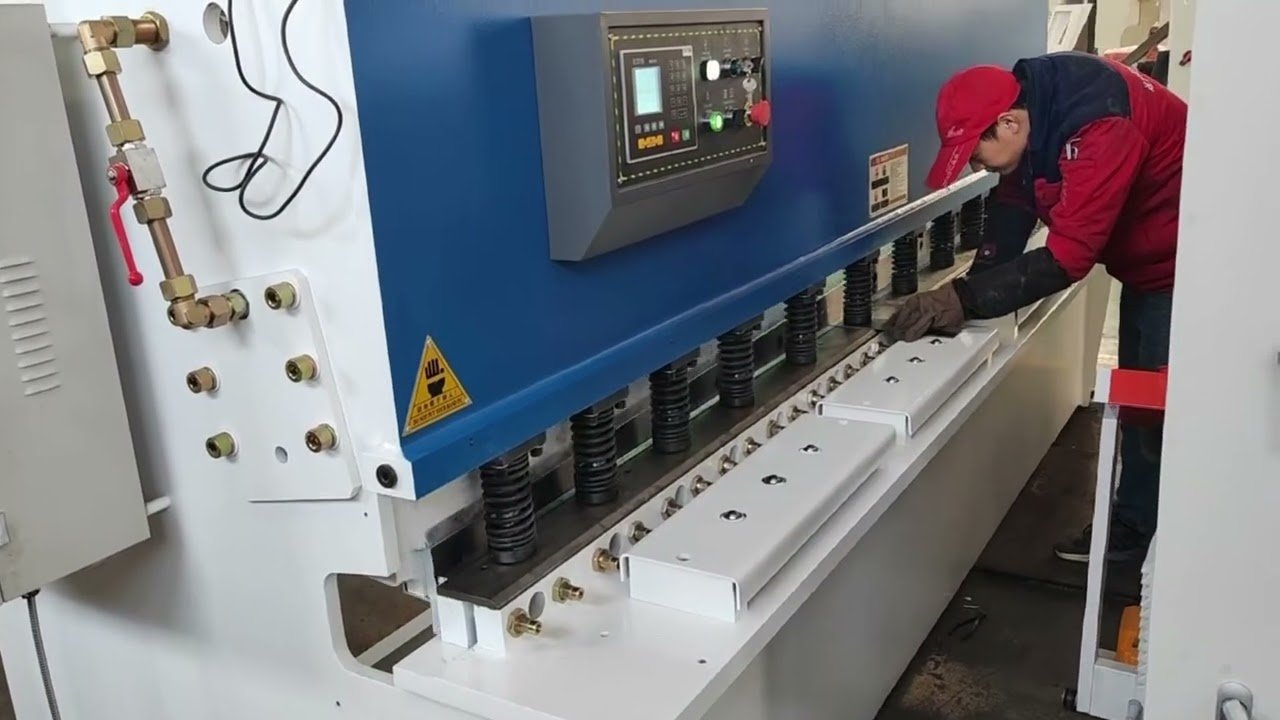
Basic Workflow Example
- Material Preparation
Select the correct material type, thickness, and sheet size. - Cutting or Shearing
Use a laser cutting machine for complex shapes, or a shearing machine for straight-line cutting. - Punching
Use a punching machine to make holes, slots, louvers, or formed features. - V Grooving
Use a V grooving machine before bending when sharp edges, small bending radius, or high-end surface results are required. - Bending
Use a CNC press brake or panel bender to form the sheet metal parts. - Rolling or Pressing
Use a rolling machine for curved parts or a hydraulic press for forming and pressing. - Welding and Assembly
Join parts together according to drawings. - Inspection
Check dimensions, bending angles, surface quality, and assembly accuracy.
A good equipment configuration should make each process work smoothly with the next process.
4. Laser Cutting Machine: For Accurate and Flexible Cutting
A laser cutting machine is usually one of the core machines in a modern metal fabrication workshop. It is suitable for cutting complex shapes, holes, curves, and high-accuracy sheet metal parts.
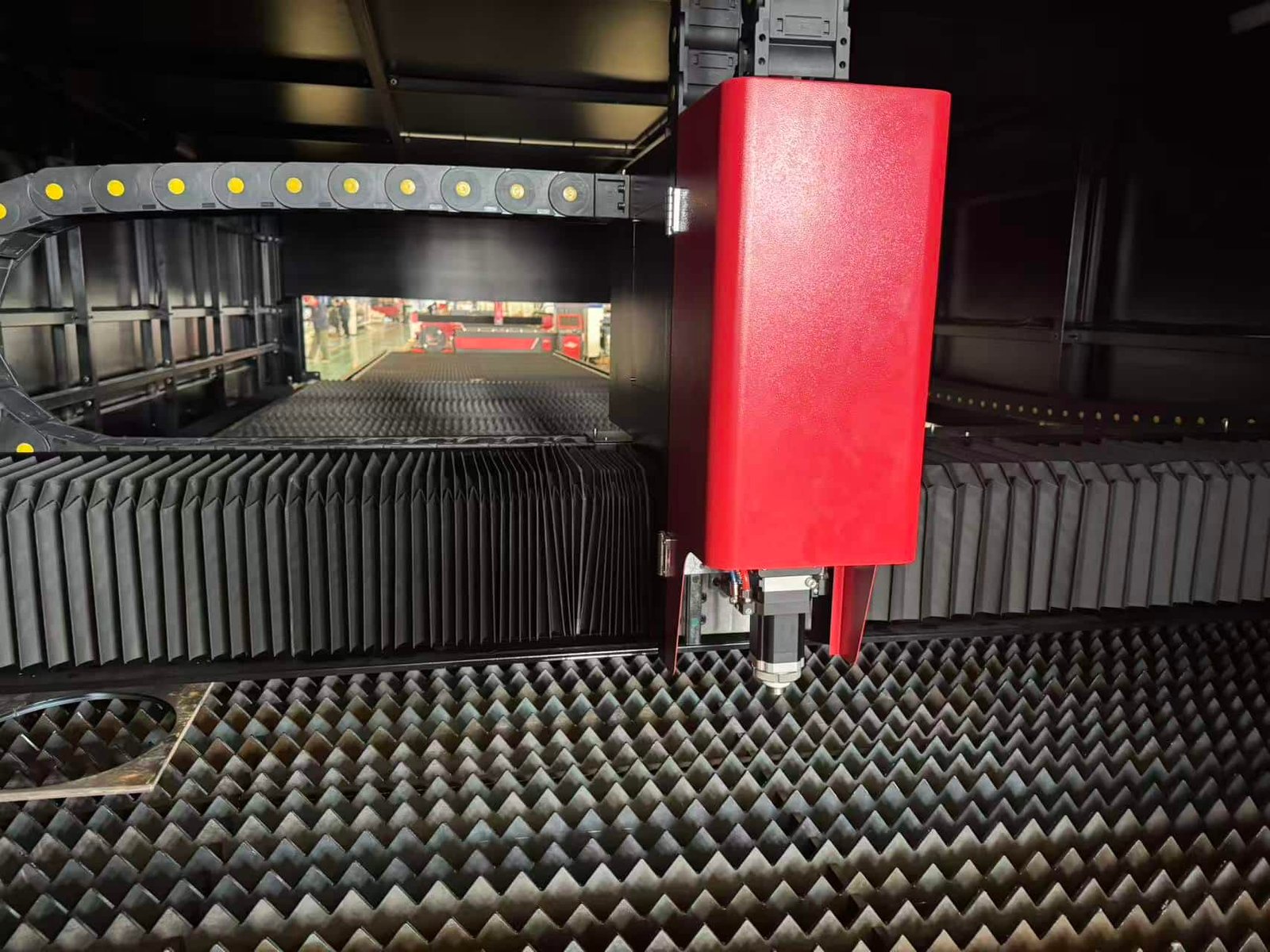
When choosing a laser cutting machine, customers should consider:
- Material type
- Maximum material thickness
- Sheet size
- Cutting accuracy
- Cutting speed
- Laser power
- Production volume
- Whether tube cutting is required
- Whether an exchange table is needed
For example, if a customer mainly cuts carbon steel within 25 mm and stainless steel within 16 mm, a 6000W fiber laser cutting machine may be a suitable option, depending on the required cutting speed, material quality, and production capacity.
A laser cutting machine is suitable for:
- Stainless steel cutting
- Carbon steel cutting
- Aluminum cutting
- Complex sheet metal parts
- High-precision components
- Flexible small-batch production
- Industrial metal parts
However, laser cutting is not always the only choice. If the factory mainly cuts simple rectangular sheets or straight-line plates, a shearing machine may be more economical.
5. Shearing Machine: For Straight-Line Sheet Cutting
A shearing machine is mainly used for straight-line cutting of sheet metal. Compared with laser cutting, shearing is simpler, faster for straight cuts, and usually more cost-effective for basic sheet preparation.
A shearing machine is suitable for:
- Straight-line cutting
- Batch sheet preparation
- Standard rectangular plates
- Lower-cost cutting requirements
- Workshops with simple cutting tasks
When choosing a shearing machine, customers should consider:
- Maximum cutting thickness
- Cutting length
- Material type
- Blade clearance adjustment
- Backgauge accuracy
- CNC control requirements
- Hydraulic system stability
For factories with both complex and simple cutting requirements, a laser cutting machine and shearing machine can work together. The laser cutting machine handles complex shapes, while the shearing machine handles straight-line cutting and basic plate preparation.
6. Punching Machine: For Holes and Forming Features
A punching machine is used to punch holes, slots, louvers, countersinks, and other forming features in sheet metal.
It is commonly used in:
- Electrical cabinets
- Control panels
- Mounting plates
- Metal doors
- Ventilation panels
- Machinery covers
- Industrial enclosures
When choosing a punching machine, customers should consider:
- Hole size
- Plate thickness
- Punching force
- Mold type
- Hole spacing accuracy
- Production volume
- Whether CNC positioning is required
For parts with many holes and repeated patterns, punching can be more efficient than using laser cutting for every feature. In many factories, laser cutting and punching can complement each other.
7. V Grooving Machine: For Sharp and High-Quality Bending
A V grooving machine is used to create grooves on the sheet metal surface before bending. This process helps reduce the bending radius and create sharper, cleaner bending edges.
V grooving is especially useful for:
- Stainless steel decorative panels
- Elevator panels
- Door panels
- Commercial metal decoration
- High-end architectural metal products
- Parts requiring sharp bending edges
- Products where surface appearance is important
Without V grooving, some stainless steel or decorative panels may have a larger bending radius or visible deformation after bending. For projects that require a clean appearance, V grooving before bending can improve the final result.
When choosing a V grooving machine, customers should consider:
- Sheet thickness
- Groove depth
- Groove accuracy
- Material type
- Table size
- Clamping system
- Cutting tool quality
- CNC control system
For factories producing elevator panels, stainless steel doors, or architectural metal products, a V grooving machine can be an important supporting machine before bending.
8. Press Brake: For Sheet Metal Bending
A press brake is one of the most important machines in sheet metal fabrication. It bends sheet metal into different angles and shapes according to the product drawings.
When choosing a CNC press brake, customers should consider:
- Bending tonnage
- Working length
- Material thickness
- Material strength
- CNC control system
- Axis configuration
- Backgauge system
- Crowning compensation
- Tooling
- Hydraulic system
- Production accuracy
In real production, many bending problems are caused by incorrect machine selection. For example, if the tonnage is not enough, thick material may require repeated testing or may not bend properly. If the backgauge is not accurate, the final part size may be unstable. If the crowning compensation is not suitable, long workpieces may have inconsistent bending angles.
For high-precision and stable production, DG Bending Machine recommends choosing a suitable CNC press brake based on actual drawings, material type, thickness, bending length, and production volume.
9. Panel Bender: For Automatic Panel Bending
A panel bender is designed for automatic bending of panel-type sheet metal parts. Compared with a traditional press brake, a panel bender is more suitable for high-volume, repeated, and standardized panel bending.
Panel benders are commonly used for:
- Electrical cabinets
- Elevator panels
- Metal doors
- Enclosures
- Household appliance panels
- Control cabinets
- Rectangular and box-type parts
A panel bender can reduce manual handling, improve bending efficiency, and increase production consistency for suitable parts.
However, it does not completely replace a press brake. A CNC press brake is more flexible for different workpiece shapes, thicker materials, and varied bending jobs. A panel bender is better for standardized panel products with repeated production.
For this reason, many factories need to compare press brake and panel bender based on their product type, production volume, labor cost, and automation requirements.
10. Rolling Machine: For Curved and Cylindrical Parts
A rolling machine is used to roll metal plates into curved, cylindrical, or arc-shaped parts.
It is commonly used for:
- Tanks
- Pipes
- Cylinders
- Curved structural parts
- Construction components
- Shipbuilding parts
- Pressure vessel components
When choosing a rolling machine, customers should consider:
- Plate thickness
- Plate width
- Minimum rolling diameter
- Material strength
- Number of rollers
- Hydraulic or mechanical structure
- Required forming accuracy
For factories producing curved metal parts, a rolling machine is an important equipment category that cannot be replaced by a press brake.
11. Hydraulic Press: For Pressing, Forming, and Correction
A hydraulic press is used for pressing, forming, straightening, correction, assembly, and sometimes deep drawing applications.
It can be used for:
- Metal forming
- Press fitting
- Straightening parts
- Assembly pressing
- Bending correction
- Mold testing
- Industrial forming processes
When choosing a hydraulic press, customers should consider:
- Pressing force
- Working table size
- Stroke
- Opening height
- Hydraulic system
- Control method
- Mold requirements
- Safety protection
A hydraulic press is often used as a supporting machine in workshops that need forming, correction, or press assembly.
12. How to Choose the Right Equipment Combination
The best equipment combination depends on the factory’s actual production requirements.
For a Basic Sheet Metal Workshop
A basic workshop may need:
- Shearing machine
- CNC press brake
- Welding equipment
This configuration is suitable for simple cutting, bending, and assembly.
For a Modern Metal Fabrication Workshop
A more advanced workshop may need:
- Fiber laser cutting machine
- CNC press brake
- V grooving machine
- Punching machine
- Welding equipment
This configuration is suitable for flexible sheet metal processing, complex shapes, and higher production quality.
For Electrical Cabinet and Enclosure Production
This type of factory may need:
- Laser cutting machine
- Punching machine
- Panel bender
- CNC press brake
- Welding equipment
If the products are mainly standardized panels, a panel bender can improve efficiency.
For Elevator and Stainless Steel Panel Production
This type of factory may need:
- Laser cutting machine
- V grooving machine
- CNC press brake
- Panel bender
- Welding and polishing equipment
A V grooving machine is especially useful when sharp bending edges and good surface appearance are required.
For Heavy-Duty Metal Fabrication
This type of factory may need:
- High-power laser cutting machine
- Heavy-duty shearing machine
- Large-tonnage press brake
- Rolling machine
- Hydraulic press
- Welding equipment
This configuration is suitable for thicker plates, larger components, and structural parts.
13. Equipment Selection Should Start from Production Requirements
Before choosing any machine, customers should first answer these questions:
- What material will you process?
- What is the maximum material thickness?
- What is the maximum sheet size?
- What is the maximum bending length?
- What accuracy is required?
- What is your daily or monthly production volume?
- Do you process simple or complex shapes?
- Do you need automatic production?
- What is your workshop space?
- What is your budget?
- Do you have product drawings?
- Will your production requirements increase in the future?
For example, if a customer needs to cut carbon steel within 25 mm and stainless steel within 16 mm, a 6000W fiber laser cutting machine may be considered. But if the same customer also needs to bend thick parts, the press brake tonnage must also be matched. If the laser cutting capacity is high but the bending capacity is too low, the whole production line will still be limited.
This is why equipment selection should be based on the complete production process, not only on one machine.
14. Common Mistakes When Choosing Sheet Metal Fabrication Machines
Many buyers make mistakes during equipment selection because they focus too much on price or single machine performance.
Common mistakes include:
- Choosing laser power without checking material thickness
If the laser power is too low, thick plates may cut slowly or fail to cut properly. - Choosing press brake tonnage without checking bending drawings
If the tonnage is not enough, bending may require repeated testing or may not meet the required angle. - Buying a panel bender without checking workpiece type
Panel benders are efficient for standardized panel parts, but they are not suitable for every bending job. - Ignoring cutting and bending capacity matching
A fast cutting machine and a slow bending process can create production bottlenecks. - Ignoring future production expansion
Equipment should not only meet current orders but also support future product changes. - Not discussing technical details before ordering
Without enough communication, the final machine configuration may not fully match production needs.
A professional equipment supplier should communicate carefully before recommending machines.
15. Why Pre-Sales Communication Matters
For sheet metal fabrication equipment, pre-sales communication is very important. A machine recommendation should not be based only on a standard catalog.
Before making a proposal, the supplier should understand:
- Customer industry
- Material type
- Thickness range
- Product drawings
- Production volume
- Accuracy requirements
- Workshop layout
- Automation needs
- Budget range
- Existing machines
- Future production plan
DG Bending Machine focuses on understanding customer requirements before recommending equipment. This helps reduce wrong machine selection, improve production efficiency, and support long-term workshop operation.
For customers who need equipment for different industries, DG Bending Machine also provides application solutions for metal fabrication workshops, automotive manufacturing, aerospace manufacturing, elevator manufacturing, shipbuilding manufacturing, and construction manufacturing.
16. Recommended Core Equipment for Metalworking Factories
For most metalworking factories, the following machines are commonly considered first:
Laser Cutting Machine
A laser cutting machine is suitable for high-precision cutting, complex shapes, and flexible production.
Shearing Machine
A shearing machine is suitable for straight-line cutting and basic sheet preparation.
Press Brake
A press brake is used for sheet metal bending and is one of the most important machines in most workshops.
Panel Bender
A panel bender is suitable for automatic bending of panel-type workpieces, especially for electrical cabinets, elevator panels, and metal doors.
V Grooving Machine
A V grooving machine is suitable for stainless steel panels, sharp bending edges, and high-end decorative metal products.
These machines can be configured separately or combined into a complete sheet metal fabrication solution.
FAQ
1. What machines are needed for a sheet metal fabrication workshop?
Common machines include laser cutting machine, shearing machine, punching machine, press brake, V grooving machine, panel bender, rolling machine, hydraulic press, welding equipment, and inspection tools. The exact configuration depends on material type, thickness, product shape, production volume, and budget.
2. Should I choose a laser cutting machine or a shearing machine first?
If your products require complex shapes, holes, curves, or high cutting accuracy, a laser cutting machine is usually better. If you mainly cut straight rectangular sheets, a shearing machine may be more economical.
3. What is the most important machine in sheet metal fabrication?
For many workshops, the press brake is one of the most important machines because most sheet metal parts require bending after cutting. However, the best equipment configuration depends on the complete production process.
4. When do I need a V grooving machine?
A V grooving machine is useful when the product requires sharp bending edges, smaller bending radius, or high-quality surface appearance. It is commonly used for stainless steel panels, elevator panels, doors, and architectural metal decoration.
5. Can a panel bender replace a press brake?
A panel bender cannot completely replace a press brake. A panel bender is efficient for standardized panel-type parts, while a press brake is more flexible for different materials, thicknesses, workpiece shapes, and bending tasks.
6. How do I choose the right sheet metal fabrication machines?
You should provide your material type, maximum thickness, sheet size, bending length, product drawings, accuracy requirements, production capacity, budget, and workshop layout. Based on this information, the supplier can recommend a suitable equipment configuration.
Conclusion
Choosing sheet metal fabrication machines is not simply about buying individual equipment. A successful metalworking factory needs machines that work together smoothly through cutting, shearing, punching, grooving, bending, rolling, pressing, welding, and inspection.
The right equipment configuration should be based on material type, thickness, workpiece size, accuracy requirements, production capacity, budget, and workshop layout. If one machine is not properly matched with the others, the whole production line may face bottlenecks.
DG Bending Machine provides sheet metal fabrication machine solutions including laser cutting machines, shearing machines, press brakes, V grooving machines, panel benders, rolling machines, punching machines, hydraulic presses, and related metalworking equipment.
If you are planning a new metal fabrication workshop or upgrading existing machines, please provide your material type, thickness range, processing size, drawings, production capacity, budget, and workshop layout. Contact DG Bending Machine to discuss a suitable machine configuration for your production needs.