
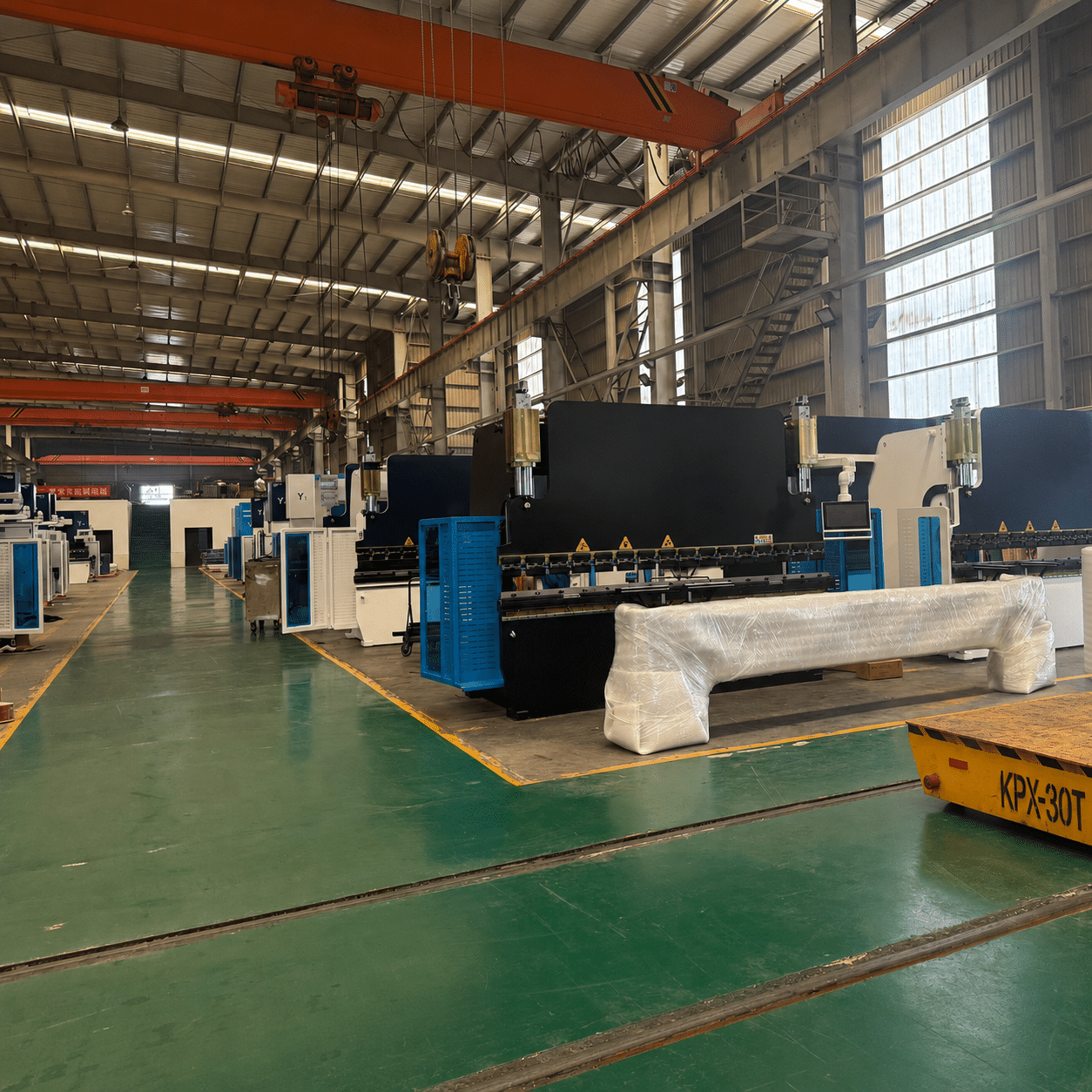
Choosing the right CNC press brake is not only about selecting a machine with enough tonnage. For a sheet metal workshop, the right press brake should match your material type, bending length, production volume, accuracy requirements, tooling, operator experience, and long-term maintenance expectations.
Many buyers focus only on the machine price at the beginning. However, in real production, problems such as unstable bending accuracy, angle inconsistency, low efficiency, difficult operation, hydraulic failure, or poor backgauge repeatability often come from incorrect machine selection.
This guide explains how to choose a suitable CNC press brake for your workshop, especially for metal fabrication workshops, electrical cabinet manufacturers, automotive manufacturing, elevator manufacturing, shipbuilding manufacturing, and general sheet metal processing factories.
1. Start with Your Main Bending Requirements
Before choosing a press brake machine, the first step is to define your actual production requirements.
You should prepare the following information:
- Material type, such as mild steel, stainless steel, aluminum, or galvanized steel
- Maximum material thickness
- Maximum bending length
- Minimum flange size
- Required bending accuracy
- Daily or monthly production volume
- Product drawings or sample parts
- Whether the workpieces are simple parts or complex multi-bend parts
- Whether future production may require larger capacity
For example, a workshop mainly bending 2–3 mm electrical cabinet panels does not need the same configuration as a factory bending thick structural steel parts. A company producing high-precision elevator components may need a different control system and backgauge configuration from a general metal fabrication workshop.
The more clearly you understand your bending requirements, the easier it is to choose the right CNC press brake model.
2. Choose the Right Tonnage
Press brake tonnage is one of the most important factors in machine selection. If the tonnage is too low, the machine may not be able to bend the required material safely. If the tonnage is too high, the investment cost and energy consumption may be unnecessary.
A general reference formula for press brake tonnage is:
Tonnage ≈ (650 × S² × L) / V
Where:
- S = material thickness in mm
- L = bending length in meters
- V = lower die opening in mm
This formula is usually used as a reference for mild steel bending. Actual tonnage may vary depending on material strength, tooling, bending method, and required angle.
For stainless steel, higher tonnage is usually required compared with mild steel of the same thickness. For aluminum, the tonnage requirement is usually lower, but surface protection and tooling selection become more important.
When choosing tonnage, it is better to calculate based on your maximum regular production requirement, not only one occasional part. If your workshop often handles different materials and thicknesses, a slightly higher tonnage margin may help improve production flexibility.
For customers who need both cutting and bending equipment, a complete metal fabrication machine solution can also help balance cutting capacity, bending tonnage, production speed, and workshop layout.
3. Confirm the Bending Length
Bending length determines the maximum workpiece size that the press brake can process.
Common working lengths include:
- 2500 mm
- 3200 mm
- 4000 mm
- 6000 mm
- Customized longer lengths
For most sheet metal workshops, 3200 mm and 4000 mm press brakes are widely used. A 3200 mm machine is suitable for many standard sheet metal parts, electrical cabinets, enclosures, doors, and medium-size components. A 4000 mm or longer press brake is more suitable for large panels, construction parts, elevator components, shipbuilding parts, or long structural workpieces.
When selecting bending length, you should consider:
- Maximum part length
- Distance between columns
- Throat depth
- Whether side feeding is needed
- Whether long workpieces require two operators
- Whether tandem press brake operation is needed for extra-long bending
If your factory needs to bend very long workpieces, a dual-machine linkage CNC press brake may be a better solution than a single oversized machine.
4. Select the Right Machine Type
Different CNC press brake types are suitable for different production needs.
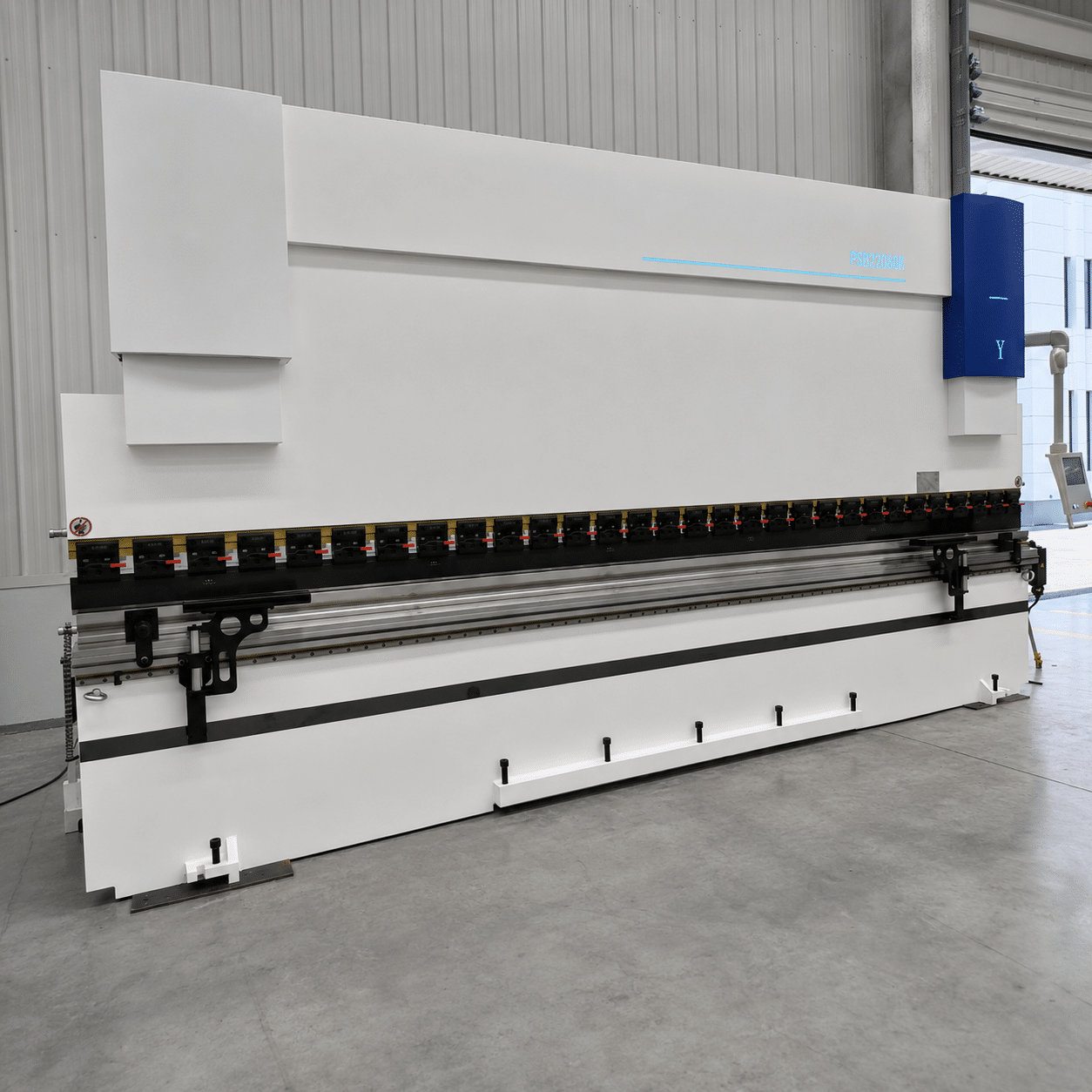
Electro-Hydraulic Synchronous CNC Press Brake
An electro-hydraulic synchronous CNC press brake uses Y1/Y2 closed-loop control to achieve stable ram synchronization and high bending accuracy. It is suitable for factories that require precision, repeatability, and stable long-term production.
This type is recommended for:
- Precision sheet metal fabrication
- Electrical cabinet manufacturing
- Elevator parts
- Automotive components
- Medium to heavy-duty bending
- Workshops requiring stable angle consistency
For many industrial buyers, the PSA Electro-Hydraulic Synchronous CNC Press Brake is a practical choice because it offers good bending accuracy, stable synchronization, and reliable performance for regular production.
Main Servo Electro-Hydraulic Synchronous CNC Press Brake
A main servo electro-hydraulic synchronous CNC press brake is designed for higher efficiency, lower energy consumption, and more stable hydraulic control. It is suitable for workshops that need better accuracy, faster response, and long-term production stability.
The PSB Main Servo Electro-Hydraulic Synchronous CNC Press Brake is recommended for customers who care about precision, energy-saving operation, stable hydraulic performance, and higher production efficiency.
Torsion Bar CNC Press Brake
A torsion bar press brake is usually more economical and easier to operate. It is suitable for standard bending jobs with moderate accuracy requirements.
This type is suitable for:
- Basic sheet metal workshops
- Standard bending parts
- Budget-sensitive buyers
- Simple operation requirements
However, compared with electro-hydraulic synchronous press brakes, torsion bar models are usually less suitable for high-precision bending, complex workpieces, or demanding batch production.
Full Electric CNC Press Brake
A full electric press brake is driven by servo motors and does not use a traditional hydraulic system. It offers clean operation, energy efficiency, low noise, and reduced maintenance requirements.
This type is suitable for:
- Small and medium precision parts
- Clean workshop environments
- High-frequency production
- Customers who want to reduce hydraulic oil maintenance
Panel Bender
A panel bender is not the same as a traditional press brake. It is more suitable for automatic bending of panels, especially in industries such as electrical cabinets, elevator panels, metal doors, and enclosures.
If your production includes many panel-type workpieces with repeated bending, a panel bender may improve efficiency and reduce labor requirements. For manufacturers in elevator manufacturing or high-volume enclosure production, comparing a press brake with a panel bender is often necessary before making an investment decision.
5. Compare Common Press Brake Options
| Machine Type | Best For | Main Advantage | Limitation |
|---|---|---|---|
| Electro-Hydraulic CNC Press Brake | Precision and industrial bending | Stable accuracy and Y1/Y2 synchronization | Higher cost than basic torsion bar models |
| Main Servo Electro-Hydraulic Press Brake | Efficient and stable production | Better energy efficiency and hydraulic response | Higher initial investment |
| Torsion Bar CNC Press Brake | Standard bending and budget projects | Lower cost and simple operation | Lower precision for complex work |
| Full Electric CNC Press Brake | Clean and energy-saving production | Low maintenance and high efficiency | More suitable for smaller precision parts |
| Panel Bender | Repeated panel bending | High automation and labor saving | Not suitable for every type of bending part |
| Dual-Machine Linkage Press Brake | Extra-long workpieces | Large bending length and heavy-duty capacity | Requires more space and configuration planning |
For customers who are still comparing different metalworking equipment, the Applications section can help you understand how different machines are used in metal fabrication, automotive, aerospace, elevator, shipbuilding, and construction industries.
6. Pay Attention to CNC Control System
The CNC control system directly affects operation convenience, programming efficiency, bending accuracy, and operator training.
Common CNC controller brands include:
- DELEM
- ESA
- CYBELEC
A good CNC controller should support accurate Y-axis control, material and tooling libraries, angle programming, deflection compensation, and multi-axis backgauge control.
For workshops with experienced operators and complex bending parts, a more advanced control system can improve programming efficiency and reduce operation mistakes. For factories with simple bending work, an entry-level or mid-level controller may be enough.
When choosing a control system, you should consider:
- Operator skill level
- Number of bending steps
- Whether offline programming is needed
- Whether graphical simulation is required
- Number of CNC axes
- Required language interface
The control system should match your actual production complexity, not just the highest available configuration.
7. Choose the Right Axis Configuration
CNC press brakes can be configured with different axis options. Common configurations include:
- Y1/Y2: ram synchronization control
- X-axis: backgauge front-back positioning
- R-axis: backgauge up-down movement
- Z1/Z2 axes: left-right movement of backgauge fingers
- V-axis: crowning compensation
A basic configuration may be enough for simple bending parts. For complex workpieces, a 4+1 axis or 6+1 axis configuration can improve flexibility and positioning efficiency.
For example:
- 4+1 axis is suitable for many standard industrial bending applications.
- 6+1 axis is better for more complex parts, wider workpieces, and higher automation requirements.
If your factory produces parts with multiple bending steps, different flange positions, or frequent product changes, a more flexible backgauge axis configuration can reduce setup time and improve production efficiency.
8. Check the Backgauge System
The backgauge system controls the positioning of the sheet before bending. Poor backgauge accuracy can cause dimensional errors, unstable bending results, and repeated rework.
A reliable backgauge system should include:
- Servo motor drive
- Precision ball screw
- Linear guide rail
- Stable backgauge fingers
- Fast and repeatable positioning
- Flexible axis configuration
For batch production, backgauge repeatability is very important. Even if the ram accuracy is good, poor backgauge positioning can still cause inconsistent parts.
When comparing press brake machines, do not only check the tonnage and length. The backgauge system is one of the key factors that affects real production quality.
9. Consider Crowning and Compensation
During bending, both the machine frame and ram may deform slightly under load. This can cause uneven bending angles across the full length of the workpiece.
Crowning compensation is used to correct this problem.
Common compensation methods include:
- Mechanical crowning
- Hydraulic crowning
- CNC-controlled automatic compensation
For long workpieces or high-precision bending, crowning compensation is very important. Without proper compensation, the bending angle in the middle of the workpiece may be different from the two ends.
If your workshop often bends long parts or stainless steel panels, you should pay close attention to the crowning system. For stainless steel decorative panels or parts requiring sharper bending edges, a V grooving machine may also be used before bending to improve the final forming effect.
10. Evaluate the Hydraulic System and Valve Group
For hydraulic and electro-hydraulic press brakes, the hydraulic system is one of the core components.
A stable hydraulic system helps ensure:
- Smooth ram movement
- Stable pressure output
- Reliable synchronization
- Lower oil leakage risk
- Longer component service life
- Easier maintenance
For high-precision CNC press brakes, the hydraulic valve group, servo valves, proportional valves, seals, pipelines, and oil tank design all affect long-term performance.
If the hydraulic system is poorly designed, customers may experience oil leakage, unstable pressure, slow response, high oil temperature, or frequent maintenance problems.
For this reason, customers should not only compare machine appearance and price. The internal hydraulic configuration should also be reviewed carefully.
If you want to learn more about DGSSP’s manufacturing background and equipment supply capability, you can visit the About DGSSP page.
11. Match the Right Tooling
Press brake tooling affects bending angle, surface quality, minimum flange, and required tonnage.
Important tooling factors include:
- Upper punch type
- Lower die V opening
- Tooling material
- Tool hardness
- Tool clamping method
- Segmented tooling requirements
- Surface protection for stainless steel or aluminum
The lower die V opening is especially important because it affects the required bending force and bending radius. A smaller V opening may require higher tonnage, while a larger V opening may create a larger bending radius.
For stainless steel or visible surface parts, tooling marks and surface scratches should also be considered. In some cases, protective film, special tooling, or V grooving may be used to improve the final bending effect.
12. Think About Efficiency and Future Production
A press brake should not only meet today’s production needs. It should also support future product changes.
If your workshop expects higher production volume, more complex parts, or tighter accuracy requirements in the future, you may need:
- Better CNC control system
- Faster backgauge
- More CNC axes
- Automatic crowning
- Quick tool clamping
- Higher repeatability
- Better hydraulic system
- Offline programming support
For factories with long-term production plans, choosing a slightly higher configuration may reduce future upgrade costs and improve overall productivity.
If your workshop also needs cutting equipment, you may consider combining a laser cutting machine with a CNC press brake to build a more complete sheet metal production process. For straight cutting and cost-sensitive production, a shearing machine may also be a practical choice.
13. Recommended DGSSP Press Brake Solutions
For customers who need stable and accurate sheet metal bending, DGSSP recommends selecting the press brake based on real production requirements.
PSB Main Servo Electro-Hydraulic Synchronous CNC Press Brake
The PSB Main Servo Electro-Hydraulic Synchronous CNC Press Brake is recommended for workshops requiring higher precision, better efficiency, energy-saving performance, stable hydraulic control, and long-term industrial production.
Suitable for:
- Precision metal fabrication
- Automotive components
- Elevator manufacturing
- Electrical enclosures
- Medium and heavy-duty bending
- Customers who need higher production stability
PSA Electro-Hydraulic Synchronous CNC Press Brake
The PSA Electro-Hydraulic Synchronous CNC Press Brake is recommended for customers who need reliable electro-hydraulic synchronization, stable bending accuracy, and practical industrial performance.
Suitable for:
- General sheet metal fabrication
- Electrical cabinet manufacturing
- Machinery parts
- Construction metal components
- Batch production workshops
Both models can be configured based on your material thickness, bending length, tonnage requirement, CNC controller, backgauge axis configuration, tooling, and safety system needs.
14. What Information Should You Provide Before Buying?
To recommend the right CNC press brake, the supplier usually needs the following information:
- Material type
- Maximum material thickness
- Maximum bending length
- Product drawings
- Required bending angle
- Required accuracy
- Daily production volume
- Existing workshop space
- Preferred CNC controller
- Budget range
- Whether special tooling is needed
- Whether future production expansion is planned
With this information, the technical team can calculate the suitable tonnage, working length, axis configuration, tooling, and machine structure.
If you are planning a new workshop or upgrading existing production equipment, you can also review DGSSP’s metal fabrication workshop solutions or browse more technical articles in the News & Updates section.
FAQ
1. What CNC control system should I choose for a press brake?
The control system should be selected based on bending complexity, operator experience, and production requirements. For precision bending and complex parts, advanced controllers from DELEM, ESA, or CYBELEC can improve programming efficiency and bending accuracy.
2. How accurate is a CNC press brake?
Press brake accuracy depends on machine structure, Y1/Y2 synchronization, hydraulic system, backgauge accuracy, tooling, material condition, and operator settings. Electro-hydraulic synchronous CNC press brakes usually provide better repeatability and angle consistency than basic torsion bar machines.
3. How do I know what tonnage I need?
Tonnage depends on material type, thickness, bending length, and die opening. You can use a reference tonnage formula, but final selection should be confirmed based on actual drawings and material requirements.
4. What is the difference between 4+1 axis and 6+1 axis press brake?
A 4+1 axis press brake is suitable for many standard bending applications. A 6+1 axis configuration provides more flexible backgauge movement, which is helpful for complex parts, wider workpieces, and higher production efficiency.
5. Why does bending angle become inconsistent?
Angle inconsistency may be caused by insufficient tonnage, material variation, incorrect tooling, poor crowning compensation, backgauge error, hydraulic instability, or wrong operator settings. Choosing the correct CNC press brake configuration can reduce these problems.
6. Can the press brake be customized?
Yes. A CNC press brake can be configured based on tonnage, bending length, stroke, daylight, throat depth, CNC controller, backgauge axes, tooling, safety protection, and production requirements.
Conclusion
Choosing the right CNC press brake requires more than comparing machine price. A suitable machine should match your material thickness, bending length, production volume, accuracy requirement, control system, backgauge, hydraulic system, tooling, and future production plan.
For workshops that require stable precision and long-term industrial performance, the PSB Main Servo Electro-Hydraulic Synchronous CNC Press Brake and PSA Electro-Hydraulic Synchronous CNC Press Brake are practical solutions for different production needs.
If you are planning to purchase a CNC press brake, please provide your material type, thickness, bending length, drawings, production capacity, and budget. Contact DGSSP to evaluate the correct tonnage, working length, CNC system, backgauge configuration, tooling, and machine structure for your workshop.