
When choosing a V Grooving Machine, customers often face one basic question: should they choose a vertical V grooving machine or a horizontal V grooving machine?
Both machines are designed to create precise V grooves in sheet metal before bending. However, their mechanical structure, sheet movement, tool movement and suitability for different workpiece sizes are different.
There is no simple rule that one type is always better than the other.
The right choice depends on your sheet size, grooving direction, accuracy requirements, finished product, production method and workshop conditions.
For stainless steel fabricators, elevator manufacturers, decorative metal processors and general sheet metal workshops, understanding these structural differences before purchasing can prevent an expensive machine-selection mistake.
1. What Is the Main Difference Between Vertical and Horizontal V Grooving Machines?
The biggest difference is how the sheet and cutting system move during grooving.
With a vertical V grooving machine, the worktable remains fixed. The cutting carriage performs the grooving movement, while the sheet is positioned longitudinally by the backgauge or feeding system.
With a horizontal V grooving machine, the sheet remains fixed on the worktable during machining. The gantry and tool carriage move along the machine guideways to complete the groove.
In simple terms:
| Machine Type | Main Movement Principle |
|---|---|
| Vertical V Grooving Machine | Tool carriage performs the cutting movement, while the sheet moves for positioning |
| Horizontal V Grooving Machine | Sheet remains stationary while the gantry and cutting carriage move |
This difference affects loading, positioning, processing large sheets and the overall production method.
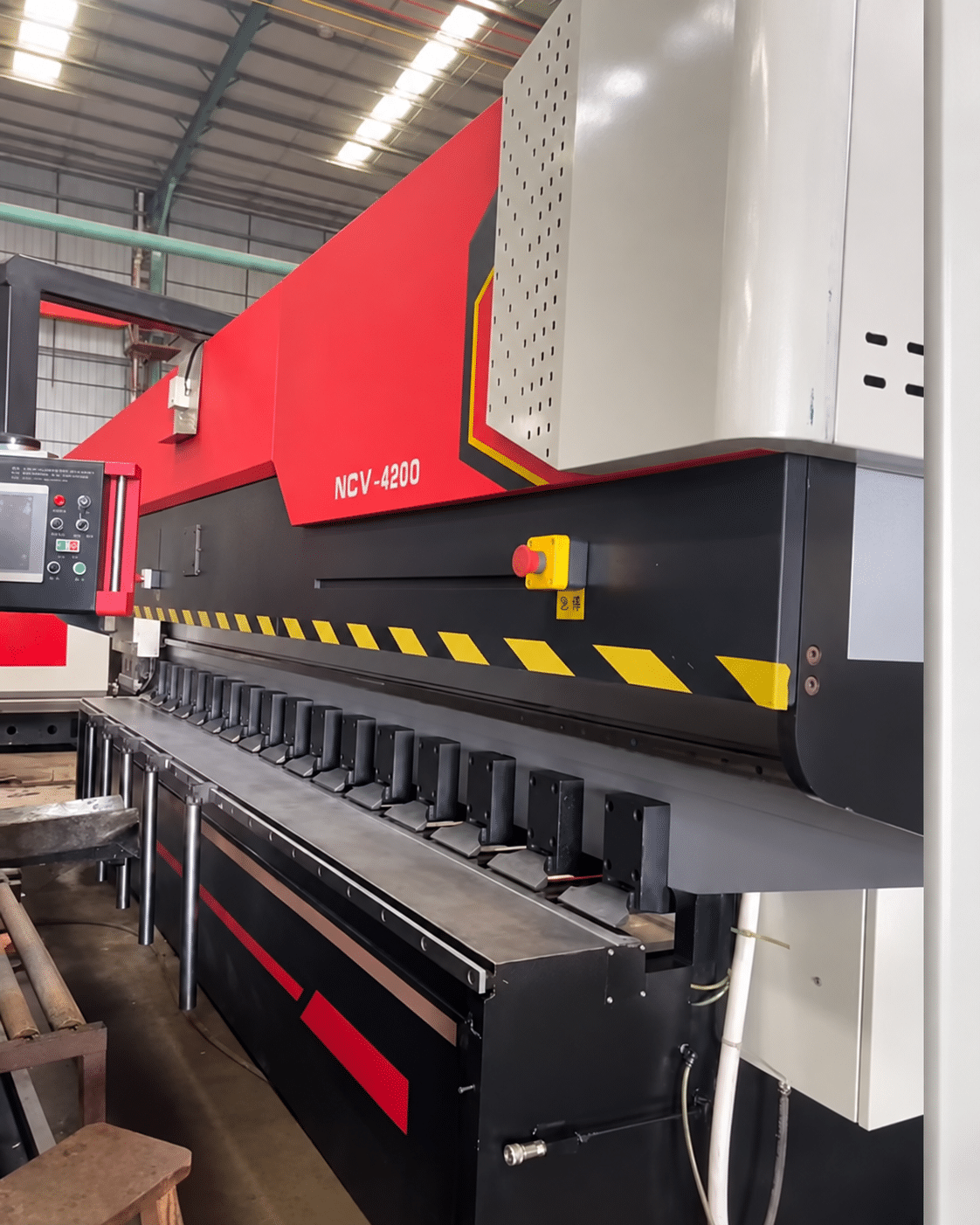
2. How Does a Vertical V Grooving Machine Work?
On a vertical V grooving machine, the worktable itself remains stationary.
The main movements are divided between the cutting carriage and the sheet.
Cutting Carriage
The cutting carriage performs the reciprocating cutting movement.
The drive system moves the carriage along the cutting direction, allowing the cutting tools to remove material from the sheet surface and create the required V groove.
Sheet Positioning
The sheet is positioned on the fixed worktable.
A servo-driven positioning system moves the sheet forward or backward to locate the next groove position. Once the required position is reached, the sheet is clamped firmly before grooving begins.
Worktable
The worktable remains stationary and provides a stable reference surface for the sheet.
Because groove depth is directly related to the relationship between the cutting tool and worktable surface, worktable condition is very important for maintaining consistent groove depth.
For workshops processing different sheet metal parts, this structure can provide a practical combination of accuracy, flexibility and relatively straightforward operation.
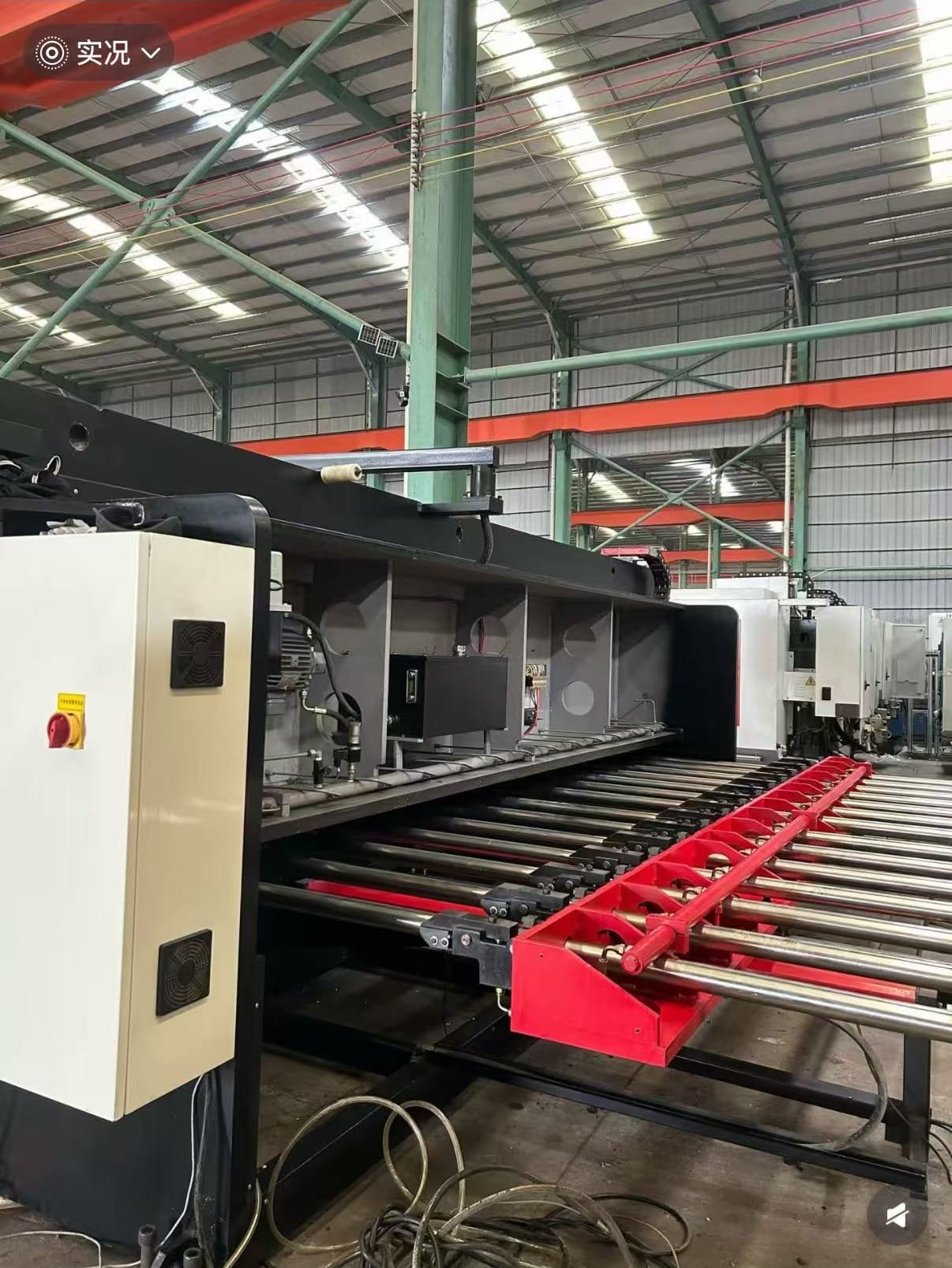
3. How Does a Horizontal V Grooving Machine Work?
The operating principle of a horizontal V grooving machine is different.
The sheet is positioned and fixed on the worktable. Instead of moving the sheet repeatedly during grooving, the gantry structure and cutting carriage move along the machine guideways.
The moving gantry carries the cutting system across the stationary sheet to machine the programmed groove positions.
This arrangement is especially useful when processing long sheets or large panels because the sheet can remain supported and stationary during the grooving process.
For large-format workpieces, reducing unnecessary sheet movement can make handling and processing more practical.
4. Vertical vs Horizontal V Grooving Machine Comparison
| Comparison Item | Vertical V Grooving Machine | Horizontal V Grooving Machine |
|---|---|---|
| Basic Principle | Cutting carriage moves while sheet is repositioned | Sheet remains fixed while gantry and cutting system move |
| Worktable | Fixed reference worktable | Large supporting worktable |
| Sheet Movement | Sheet moves for positioning | Sheet normally remains stationary during grooving |
| Tool Movement | Cutting carriage performs reciprocating cutting | Gantry and cutting carriage travel over the sheet |
| General Accuracy | High accuracy; in our experience slightly better stability is possible | Also capable of high-accuracy grooving |
| Long Sheet Processing | Depends on sheet positioning and handling | Often preferred for long sheets |
| Large Panel Processing | Possible depending on machine configuration | Often more practical for large panels |
| Worktable Flatness | Very important | Very important |
| Typical Selection Factor | Accuracy, flexibility and production requirements | Long sheets, large panels and stationary-sheet processing |
The table should only be used as a general selection guide. The final decision should be based on actual drawings, sheet dimensions and groove requirements.
5. Which V Grooving Machine Is More Accurate?
Customers often ask whether vertical or horizontal V grooving machines are more accurate.
In actual production, the accuracy difference between the two types does not have to be large when both machines are properly manufactured, installed and adjusted.
Based on our production experience, the vertical structure can provide very stable grooving performance and may offer an advantage in precision stability in suitable applications.
However, machine type alone does not determine accuracy.
Actual V groove accuracy also depends on:
- Machine rigidity
- Worktable flatness
- Tool condition
- Positioning system
- Clamping stability
- Cutting parameters
- Sheet condition
- Machine installation and calibration
Customers should therefore avoid choosing a machine only because one design is advertised as “more precise.”
The complete machine structure and actual processing requirements are more important.
6. Why Is Worktable Flatness Important?
Worktable flatness directly affects groove depth consistency.
For our grooving equipment, the worktable flatness requirement is controlled within approximately ±0.03 mm.
If the worktable surface is not sufficiently flat, the distance between the cutting tool and sheet surface can change during machining.
This can result in:
- Uneven groove depth
- Inconsistent remaining material thickness
- Different bending radii
- Inconsistent bending angles
- Poor appearance after bending
This becomes especially important when the grooved sheet will later be formed on a CNC press brake.
V grooving and bending should therefore be considered as connected processes rather than completely separate operations.
7. Which Machine Is Better for Long Sheets?
For long-sheet processing, we generally recommend considering a horizontal V grooving machine first.
Because the sheet remains stationary on the worktable while the gantry and cutting system move, the structure can be more convenient for long workpieces and large panels.
This can be useful for products such as:
- Long stainless steel decorative panels
- Elevator panels
- Architectural metal panels
- Large metal doors
- Long sheet metal components
However, “long sheet” alone should not determine the final machine selection.
The sheet width, groove direction, material, loading method and finished product should also be evaluated.
8. Which Machine Is Better for Large Panels?
Large sheet size creates two important challenges:
- Supporting the sheet correctly
- Moving and positioning the sheet accurately
For large-format panels, a horizontal V grooving machine can have an advantage because the sheet remains stationary during the cutting process.
The moving gantry performs the machining instead of repeatedly repositioning a large workpiece.
This is one reason horizontal V grooving machines are often considered for large sheet metal panels and long decorative components.
For factories processing large elevator skins or architectural stainless steel panels, this should be considered during machine selection.
9. Does Vertical or Horizontal Structure Affect Bending Quality?
The purpose of V grooving is not simply to remove material.
The groove must support the following bending process.
A well-controlled V groove can help:
- Reduce the bending radius
- Create a sharper visible corner
- Improve bending appearance
- Reduce the bending force required
- Improve consistency between parts
This is particularly important for stainless steel decorative panels and visible products.
You can read our separate guide on how to choose a V grooving machine for stainless steel bending if your main concern is groove quality before press brake forming.
Whether you choose a vertical or horizontal machine, groove depth must remain consistent across the workpiece.
If groove depth changes, the remaining material thickness also changes, which can directly affect the final bending result.
10. How Should Elevator Manufacturers Choose?
Elevator manufacturing is one of the common applications for V grooving.
Visible stainless steel components such as elevator door panels and cabin panels often require:
- Clean surfaces
- Sharp bending lines
- Consistent groove depth
- Stable dimensional accuracy
- Good appearance after bending
For long elevator panels, a horizontal V grooving machine can be considered because of its suitability for long-sheet and large-panel processing.
For applications where precision stability, flexible sheet processing and different workpiece requirements are more important, a vertical machine may also be suitable.
The correct solution still depends on actual elevator panel drawings.
Our Elevator Manufacturing Machinery page explains how V grooving works together with laser cutting and CNC bending in elevator sheet metal production.
11. A Real Inquiry Example from South Korea
We received an inquiry from a customer in South Korea involved in elevator manufacturing.
The customer processes stainless steel and requires longitudinal V grooving.
This information is useful, but it is not enough to recommend the final machine configuration immediately.
Before deciding whether a vertical or horizontal V grooving machine is more suitable, we would still need to confirm:
- Sheet thickness
- Sheet length
- Sheet width
- Groove depth
- Groove angle
- Number and position of grooves
- Required production capacity
- Finished elevator component
- Accuracy requirement
This is a good example of why machine selection should not be based only on industry or material.
Two elevator factories can process stainless steel but still need different grooving machines because their panel sizes, groove directions and production volumes are different.
12. Do Not Choose Only by the Machine Name
One common purchasing mistake is assuming:
“Vertical is always more accurate.”
or:
“Horizontal is always better for production.”
Neither statement should be used as a universal rule.
Machine selection should start from the actual workpiece.
Before comparing equipment, first answer these questions:
- What material are you processing?
- What is the sheet thickness?
- What is the sheet length and width?
- Is the workpiece long or relatively small?
- What groove direction is required?
- How deep should the V groove be?
- What bending angle is required afterward?
- What is the finished product?
- What production capacity is required?
- What accuracy is required?
Only after these points are clear does it make sense to compare vertical and horizontal machine structures.
13. Vertical V Grooving Machine: When Should You Consider It?
A vertical V grooving machine is worth considering when your priority is stable, accurate V grooving and your workpiece dimensions and production method match a sheet-positioning structure.
It can be especially useful when:
- Stable groove depth is important
- Different workpieces need to be processed
- The factory requires flexible sheet metal grooving
- The workpiece can be positioned conveniently on the machine
- Accuracy stability is an important purchasing criterion
The exact machine size and configuration should be determined from actual processing requirements.
14. Horizontal V Grooving Machine: When Should You Consider It?
A horizontal V grooving machine should be considered when the factory frequently processes:
- Long metal sheets
- Large-format panels
- Long stainless steel decorative parts
- Elevator panels
- Architectural metal panels
Because the sheet remains stationary while the gantry and cutting system move, this structure can be convenient for large and long workpieces.
Again, the final recommendation should be based on drawings and production requirements rather than sheet length alone.
15. Information to Provide Before Choosing a V Grooving Machine
To recommend the correct vertical or horizontal V grooving machine, the following information is useful:
- Material type
- Sheet thickness
- Sheet length
- Sheet width
- Required groove depth
- Required groove angle
- Grooving direction
- Finished product
- Production capacity
- Accuracy requirement
- Budget
- Country or installation location
If possible, provide the actual product drawing.
A drawing often gives the machine supplier much more useful information than simply saying, “I need a V grooving machine.”
For factories planning a complete cutting, grooving and bending process, you can also review our metal fabrication workshop solutions.
FAQ
1. What is the biggest difference between a vertical and horizontal V grooving machine?
The main difference is the movement of the workpiece and cutting structure. On a vertical V grooving machine, the cutting carriage performs the cutting movement while the sheet is repositioned. On a horizontal machine, the sheet remains stationary and the gantry with the cutting system moves over the workpiece.
2. Which V grooving machine has better accuracy?
Both structures can achieve accurate grooving when properly designed, manufactured and calibrated. Based on our experience, the vertical structure can provide very stable accuracy in suitable applications, but the final result also depends on worktable flatness, machine rigidity, positioning, clamping and tool condition.
3. Which machine is better for large stainless steel sheets?
For long or large-format stainless steel sheets, a horizontal V grooving machine is often worth considering because the sheet remains stationary while the gantry performs the cutting movement.
4. Why is worktable flatness important on a V grooving machine?
Worktable flatness affects the distance between the cutting tool and sheet surface. If this distance changes, groove depth may become inconsistent, which can affect the following bending radius and bending angle.
5. Does groove depth affect press brake bending?
Yes. Groove depth changes the remaining material thickness at the bending line. If groove depth is inconsistent, the final bending result can also become inconsistent.
6. Is a horizontal V grooving machine always better for long sheets?
Not automatically. Long-sheet processing is one reason to consider a horizontal machine, but material, sheet width, groove direction, loading method, accuracy and finished product must also be considered.
7. How do I know which type is suitable for my factory?
Provide the material, thickness, sheet length and width, groove depth, groove angle, grooving direction, production volume, finished product and accuracy requirement. The machine configuration can then be evaluated based on the actual workpiece.
Conclusion
Vertical and horizontal V grooving machines perform the same basic task, but they use different mechanical and workpiece movement structures.
A vertical machine uses a fixed worktable with cutting-carriage movement and sheet positioning. A horizontal machine keeps the sheet stationary while the gantry and cutting system move across the workpiece.
For long sheets and large panels, a horizontal V grooving machine is often worth considering. For applications where stable accuracy and flexible processing are priorities, a vertical V grooving machine can also be a strong solution.
The most important point is not to choose by machine name alone.
Choose according to your actual material, sheet size, groove direction, groove depth, finished product, production capacity and accuracy requirements.
If you are comparing vertical and horizontal V grooving machines, contact DGSSP and send us your material, thickness, sheet dimensions, groove requirements and product drawings. We can evaluate the appropriate V grooving solution based on your actual production needs.